What the Research Says
Harvard Business Review published a study that looked at lead response times across thousands of companies. The finding was simple and brutal: leads contacted within five minutes of their inquiry were far more likely to qualify than leads contacted later.
Not twice as likely. Twenty-one times.
Separate speed-to-lead benchmarks often make the same practical point: the company that responds first has a meaningful advantage because the buyer's first real conversation shapes the rest of the decision.
These numbers are not specific to cleaning, but they apply directly to how commercial cleaning bids work. A facility manager requesting proposals is typically reaching out to three or four companies at the same time. The company that responds within minutes sets the baseline. The company that responds the next day is playing catch-up against a conversation that already started without them.
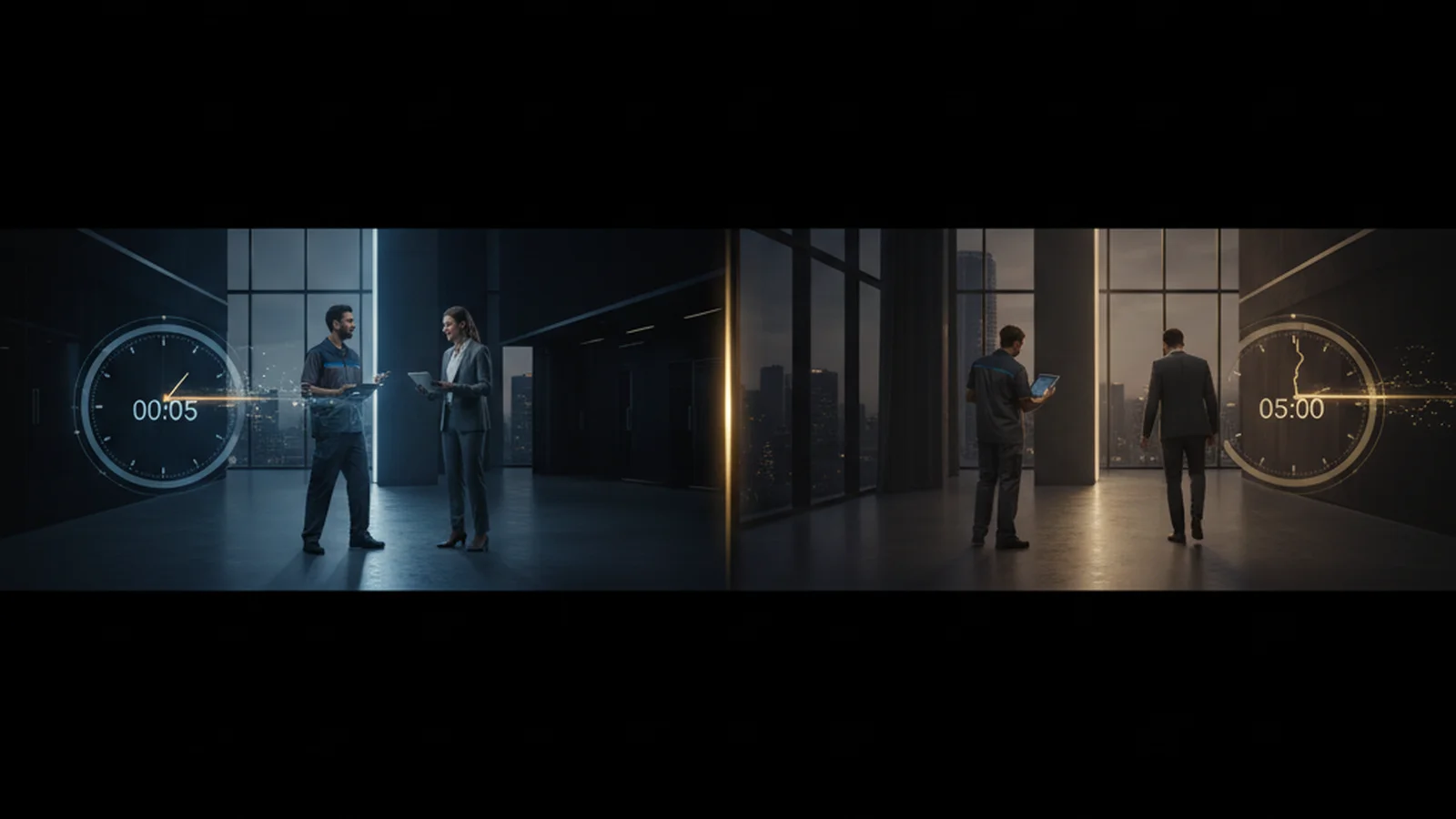
5 Minutes vs 5 Hours
Here is what actually happens in each scenario when a facility manager fills out a contact form on your website at 10 AM on a Tuesday.
Prospect submits inquiry. System sends immediate text and email acknowledging the request, confirming service area, and offering a walkthrough link.
Prospect replies to text with building address. System confirms receipt and owner is notified.
Owner calls prospect directly. They schedule a walkthrough for Thursday.
Walkthrough completed. Proposal sent same day. Contract signed the following week.
Prospect submits inquiry. No response. Owner is at a job site and will check messages later.
Prospect has already received responses from two other companies. One has a walkthrough scheduled for tomorrow.
Owner finally sees the inquiry. Calls the prospect. Gets voicemail. Leaves a message.
Prospect calls back to say they went with another company. They liked your website but the other company moved faster.
The five-hour company did nothing wrong except wait. Their price might have been better. Their reviews might have been stronger. Their work might have been higher quality. None of that mattered because they were not in the conversation when the decision was being shaped.
Why This Hits Cleaning Companies Harder
Cleaning companies are uniquely vulnerable to the response time problem because of how the business operates. The owner or the person handling sales is almost never at a desk. They are at a building doing a walkthrough, driving between accounts, managing a team on site, or dealing with a client issue.
When a lead comes in at 10 AM, the owner might not see it until 2 PM. By then, the prospect has talked to two competitors and scheduled a walkthrough with the one that responded first. The owner calls back, gets voicemail, and the opportunity quietly dies.
This is not a marketing problem. The marketing worked. It got the prospect to reach out. The failure is in the gap between when the inquiry arrives and when a human gets to it. That gap is where most cleaning companies lose the most revenue without ever knowing it.
One of our clients lost a $30,000 per month cleaning contract because they could not respond fast enough. The prospect had told them directly that they wanted to work together. The marketing had made them feel like they already knew the company. But a competitor submitted a proposal hours before theirs arrived, and the prospect had already committed. That is $360,000 in annual revenue, gone.
The After-Hours Problem
The response time issue gets worse after business hours. A facility manager who works late might fill out your form at 7 PM. If your system does not respond until 9 AM the next morning, that is 14 hours of silence. In that window, every competitor with an automated response has already started a conversation.
After-hours inquiries are often some of the highest-intent leads you will get. The person is thinking about this outside of work hours, which usually means it is a priority for them. Losing those leads to silence is a structural problem, not a discipline problem. No owner should be expected to respond to inquiries at 11 PM. But a system should.
After-hours capture does not need to be complicated. An automated text or email that acknowledges the inquiry, confirms service area, and offers a next step is enough to keep the lead warm until a human can follow up in the morning. The prospect knows they were heard. That keeps them from filling out the next company's form.
How to Fix It
The fix is straightforward: remove the human from the initial response. Not from the relationship. Not from the walkthrough. Not from the sale. From the first reply.
When a lead comes in, the system sends an immediate response. A text, an email, or both. The message references what they asked about, confirms you operate in their area, and offers a clear next step like scheduling a walkthrough. That first touchpoint happens in seconds, not hours.
After the instant response, the system runs a follow-up sequence. If the prospect does not respond within an hour, a second message goes out. If they still have not engaged by the next morning, a third. The cadence and content adjust based on the type of lead. A small office inquiry gets a faster, shorter sequence. A large facility inquiry gets a longer nurture with more information.
The owner only gets involved when the prospect is ready for a real conversation. By then, the relationship has already started. The prospect already has a positive impression of the company because they received an immediate, professional response when they expected to wait.
For the full breakdown of how automated lead follow-up works across different account sizes and buying stages, our lead follow-up guide goes deeper. And for the broader picture of where lead response fits in the complete revenue pipeline, the lead generation pillar guide covers every stage.
Want to know how fast your company actually responds to leads? We will audit it for free.
Get a Response Audit →Under five minutes is the best target. Harvard Business Review research found that leads contacted quickly are far more likely to qualify than leads contacted later. For cleaning companies, where prospects are often requesting bids from multiple providers at the same time, being first to respond sets the tone for the entire relationship.
Slow response does not kill every deal, but it does put you behind before the sales conversation starts. If your average response time is measured in hours rather than minutes, you are letting faster competitors shape the buyer's expectations first. The leads are not bad. The timing is.
Yes. Automated lead response systems send an immediate reply to every inquiry, day or night, without requiring you to be at your phone. The initial response acknowledges the inquiry, provides relevant information, and starts a follow-up sequence. You only get involved when the prospect is ready for a walkthrough or a deeper conversation.
Yes, but differently. For large accounts, the initial response speed still matters for setting the tone, but the follow-up becomes a longer nurture process. A facility manager evaluating a major cleaning contract will take weeks or months to decide, but the companies that responded quickly and stayed in touch consistently are the ones that make the shortlist.
Any personalized acknowledgment that shows a real company received the inquiry and is ready to help. An automated text or email that references their inquiry type, confirms you service their area, and offers a next step like scheduling a walkthrough. A generic auto-reply saying your message was received does not have the same effect. The response needs to move the conversation forward.